
Chegeree Cliffs
a 110-acre preserve in Carter County, KY
Property Donation: $259,000
Stewardship Campaign: $250,000
Scroll down to see details
The Arc’s first preserve in Kentucky!
A short distance south of the Ohio River in the hills of Carter County lies the first-ever Arc of Appalachia Preserve established within the boundaries of Kentucky.
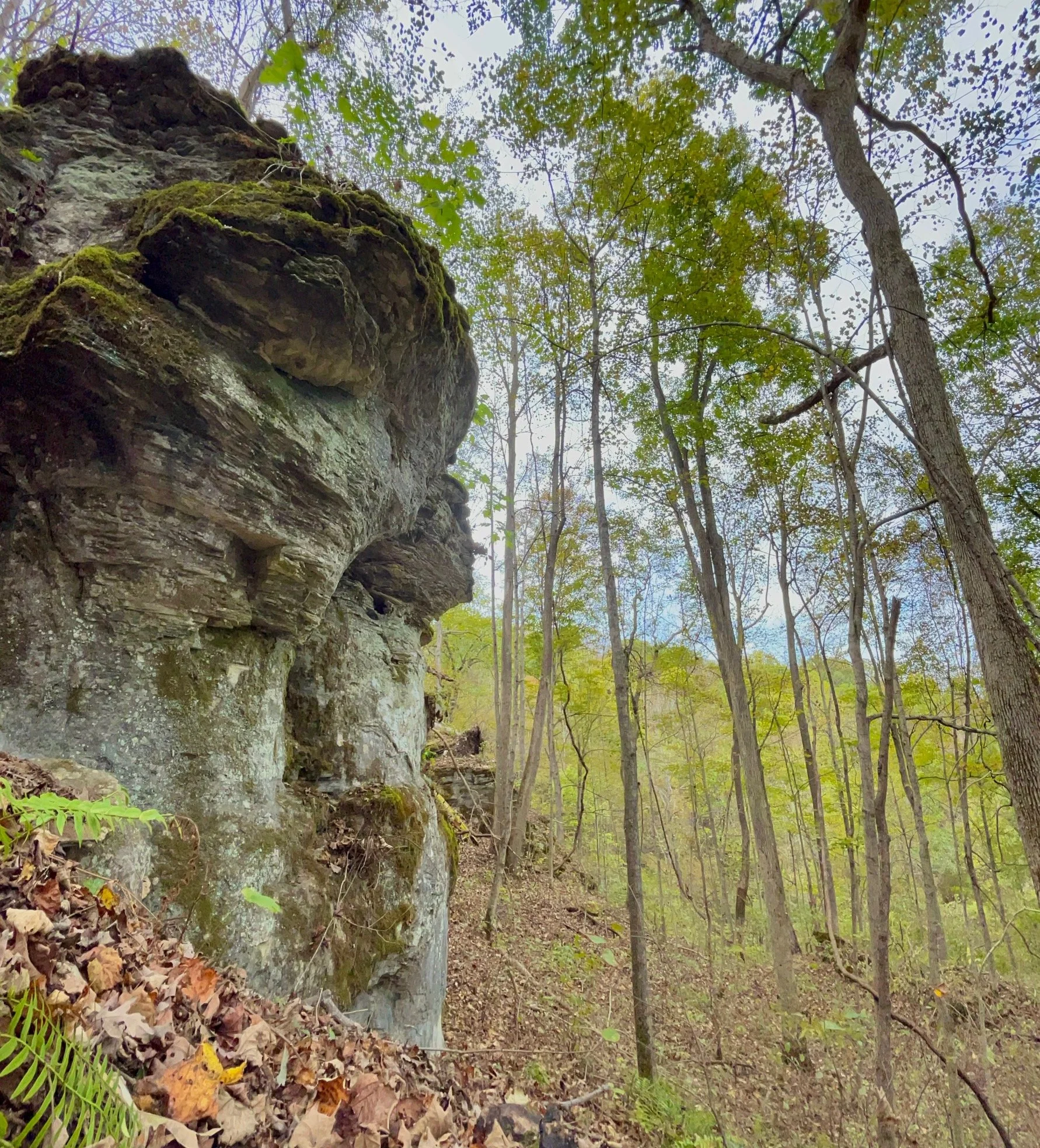
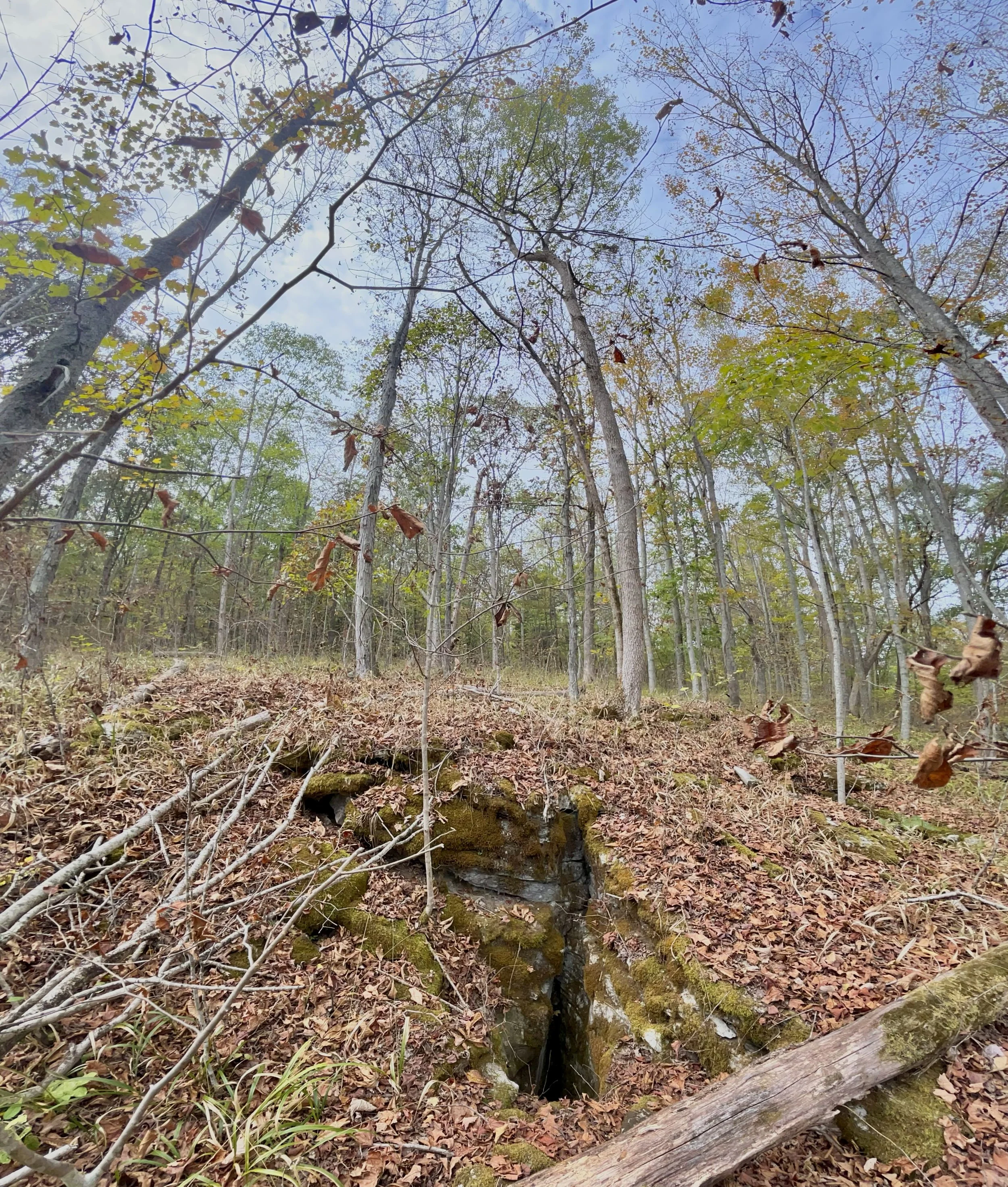
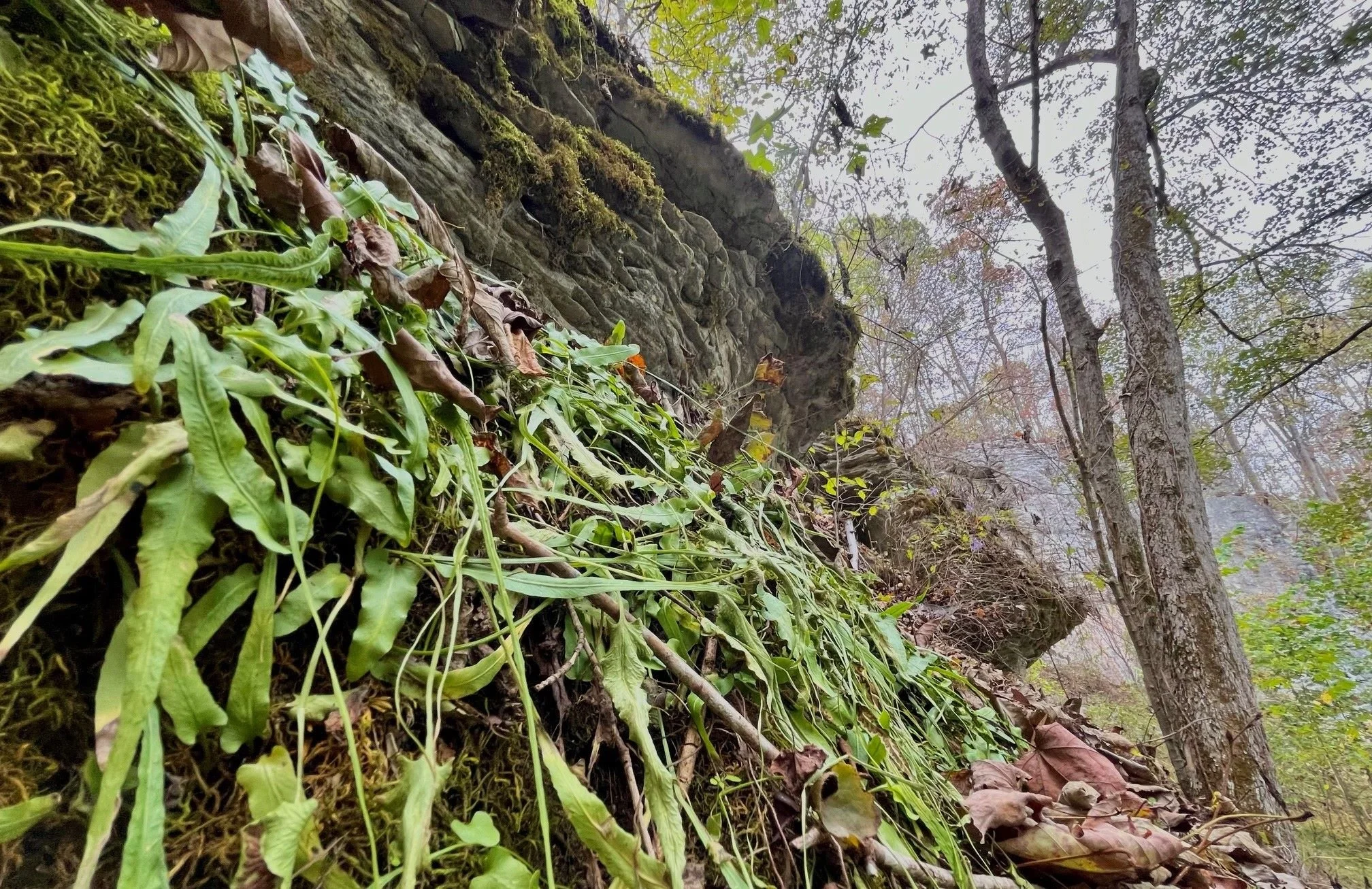
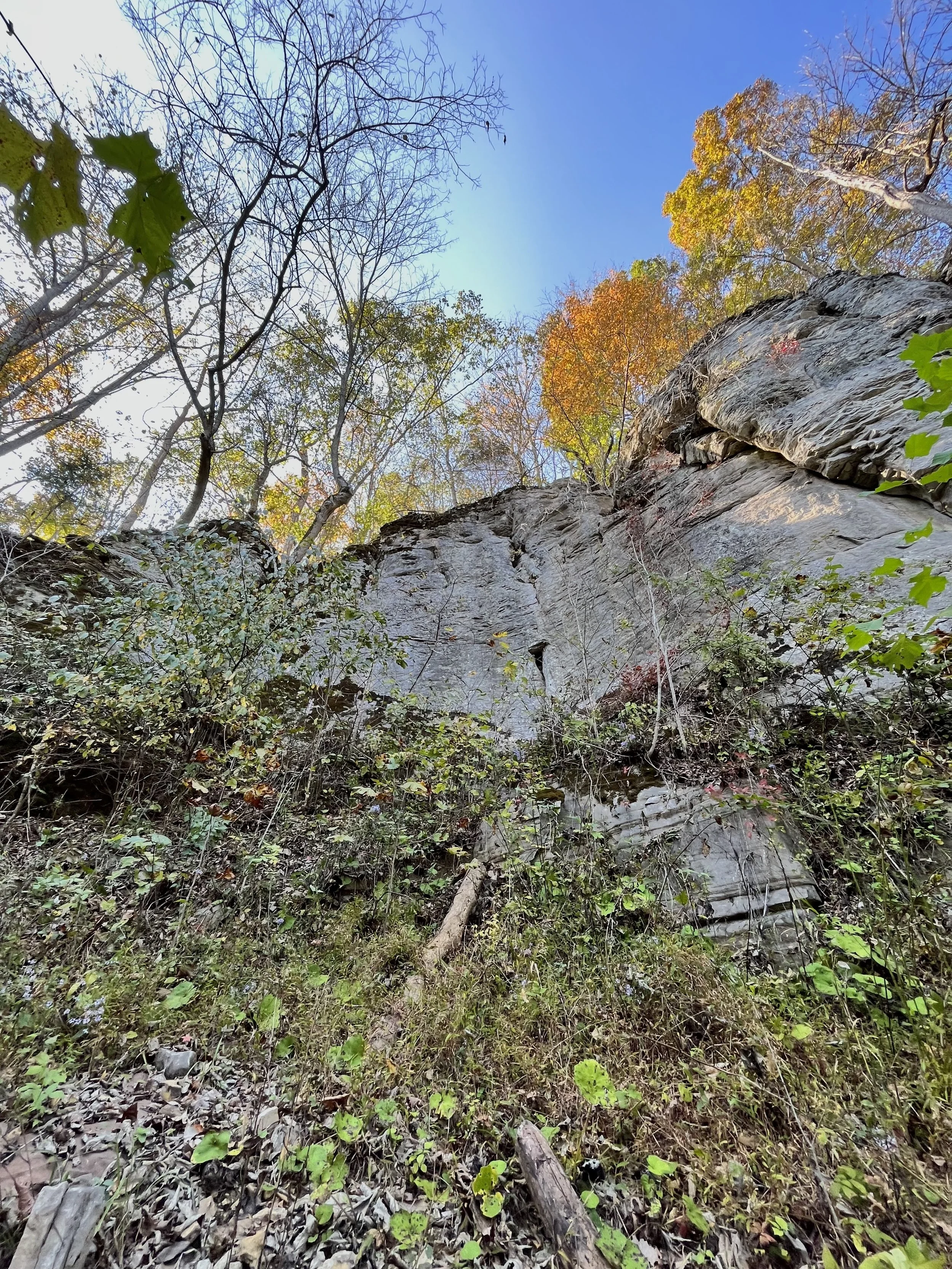
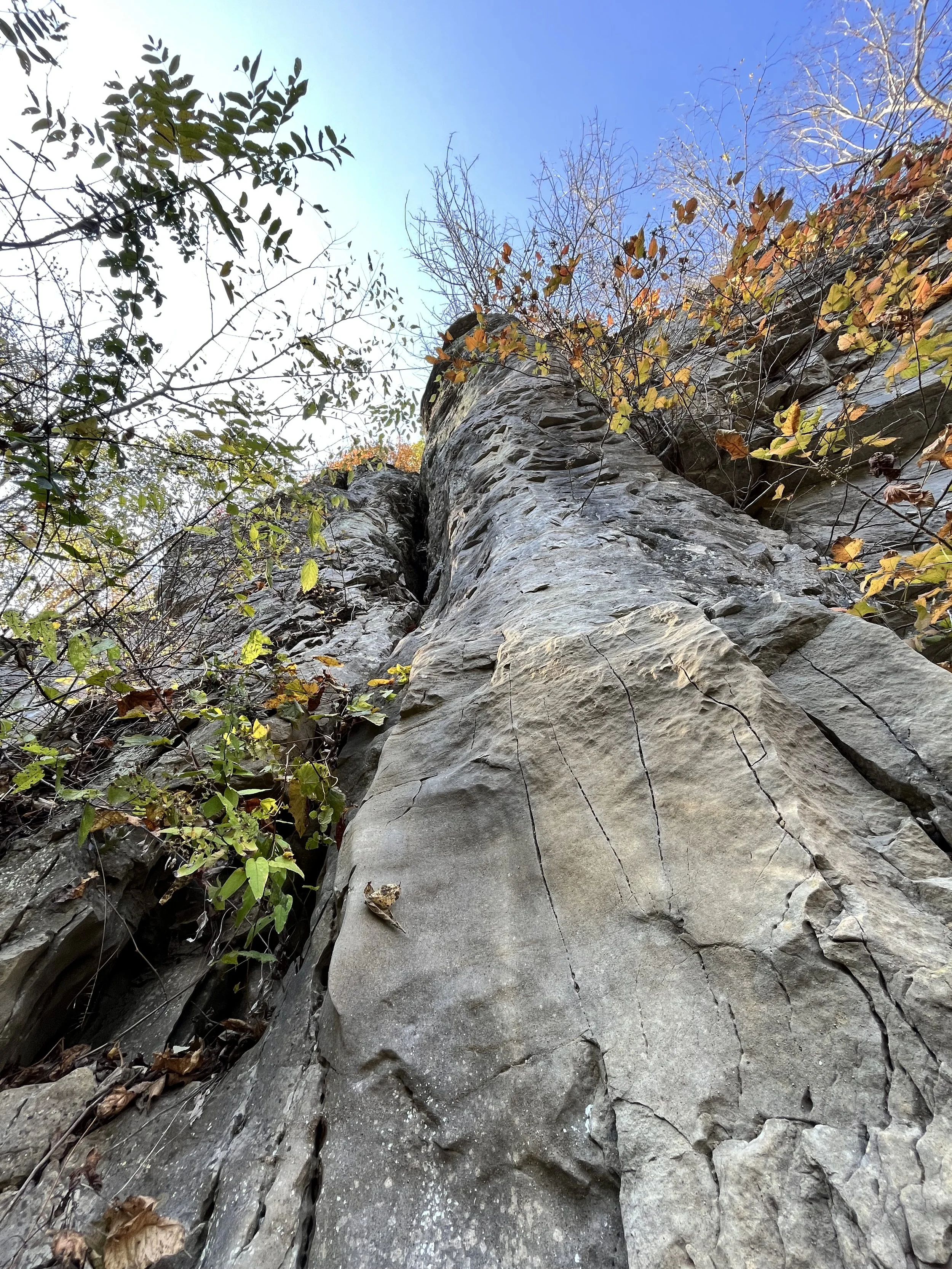
Chegeree Cliffs, as it is now known under the perpetuity of Arc protection, is a 110-acre preserve made up of younger but healthy mixed woods on rugged, steep valley slopes capped with massive mississippian-age limestones and karst-rich uplands. Maple-Beech-Poplar-Basswood-Ash and Chinquapin Oak forests shelter rich boulder-strewn talus along impressive limestone cliffs exposed on the southwest side of the preserve. Alkaline-loving flora proliferate in extraordinary numbers here, with dense colonies of Walking Fern (Asplenium rhizophyllum), Sharp-Lobed Hepatica (Hepatica acuminata), and Bulblet Fern (Cystopteris bulbifera) commonly intermingled on moss-covered limestone faces, boulders, and mineral-rich soils. Dry mixed Oak-Hickory forests are predominant on the gently sloped ridgetops capping the cliffs - with numerous sinkhole depressions scattered throughout, revealing the highly karstic nature of the preserve. Along many of the cliff edges, Prickly Gooseberry (Ribes cynosbati) is abundant - a particularly uncommon shrub south of the Ohio River in Kentucky, especially in the northeast part of the state, where it becomes rare, with isolated populations only documented here in the Carter County area. A preliminary day-trip in 2025 by Arc staff to Chegeree Cliffs Preserve has already revealed the presence of Black-Stemmed Spleenwort (Asplenium resiliens), where it is near the northern fringes of its range. More focused survey/inventory work planned for 2026 will almost certainly uncover additional finds that help us better understand the conservation value of the preserve. More importantly, it will allow the Arc’s Land Stewardship Team to determine what protective and restorative efforts are needed.
Our Vision.
Scroll down below the photo gallery for details on the Stewardship Campaign.
All Photos by Elijah Crabtree

Why Endowing Land Stewardship Is So Important for the Future
Each Arc Preserve requires enduring stewardship. To buy a preserve and not maintain it with the proper equipment, attention, and “boots on the ground” would be deeply irresponsible because an ignored preserve is a preserve only in name. No one’s land is everyone’s land.
This campaign is for the first endowment funds collected for Arc preserves in Kentucky. If we can build our Stewardship Funds, there is a lot more Kentucky treasures we are eager to preserve!!
The best and truly only insurance for successfully caring for Arc preserves is to build strong balances in our Stewardship Endowment Funds so that, over time, the fund’s annual income will substantially contribute to the yearly costs of sustainable stewardship. On the average, for every $1.00 invested in land acquisition, another $1.00 is needed in the endowment fund. For our larger preserves, the cost is much higher. We have a realistic chance of achieving sustainability if many of our Arc supporters choose to remember us in their wills and trusts. We also encourage donors to tick off the “restricted donation” option that will direct 50% of the gift to land acquisition and 50% to our primary “Stewardship Forever Endowment Fund.” Or, include a note with your check. See the following articles for deeper information:
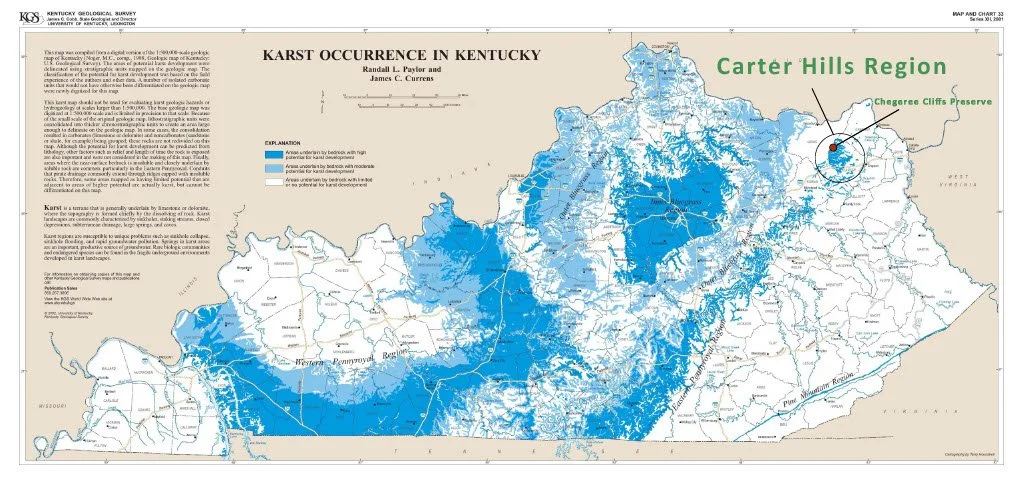
The Carter Hills region, where Chegeree Cliffs Preserve is found, stands out as a remarkable hotspot of rugged karst-rich hills, cliffs, narrow valleys, and gorges found in the Tygarts Creek watershed along the western front of the Eastern Kentucky Coal Fields. Carter Caves State Resort Park, is the most exemplary representation of the region with ecologically sensitive gorges, natural bridges, and over 20 publicly-accessible caves across 2,000 acres. The Kentucky Pennyroyal and Bluegrass regions, further to the southwest, are internationally-renowned for their karst landscapes, harboring some of the largest cave systems ever surveyed, including Mammoth Cave. The Carter Hills region is a distant northeastern outlier of this world-famous karst. Specifically, it is at the northeastern extreme of the Eastern Pennyroyal region that occurs conspicuously as a thin southwest-to-northeast band of rugged upland limestones and karst landscapes that disappear just south of the Ohio River. Its fringe, discontinuous connection to the larger Kentucky karst heartland has influenced its recognition as a distinct karst-rich ecoregion, but the geological relation is clear.
What is Karst? Karst is a landscape characterized by the presence of sinking streams, caves, sinkholes, and springs; formed by the gradual chemical dissolution of carbonate bedrock, mainly limestone and dolomite, over hundreds of thousands to millions of years.
The occurrence of well-developed sinkholes and sinkhole depressions along the ridgetops of Chegeree Cliffs indicates there are likely well-developed subterranean systems of solution channels, narrow caverns, and other openings deep within these limestones. The extent of which is unknown, as there are no accessible solution cave openings exposed in the preserve, older sinkhole openings tend to be blocked with sediment fill from the surrounding above-ground soils collapsing inward over time.
This locally unique geology serves as an important resource for sensitive cave ecosystems and limestone cliff-loving flora and fauna. Many of which are at the geographical extremes of their range in northeast Kentucky, with population strongholds elsewhere in neighboring limestone-rich ecosystems of the Bluegrass, Pennyroyal, and Central Appalachians.
Nationally Significant Bat Hibernacula. Well-researched caves in the Carter Hills region have shown to provide essential hibernacula for several rare and endangered bat species. “Bat Cave” located in Carter Caves State Resort Park, has Kentucky’s largest concentration of federally endangered Indiana Bats (Myotis sodalis), at around 40,000 bats. This sounds like a very large number, but this a shockingly stark reduction from its historical numbers 50+ years ago, when the cave hosted over 100,000 Indiana Bats. The Virginia Big-Eared Bat (Corynorhinus townsendii ssp. virginianus), another federally endangered species, is notably restricted in the state to the upper Eastern Pennyroyal karst that comes into Carter Hills region. Unlike the Indiana Bat, new research has determined that Virginia Big-Eared Bat populations are expanding. New land acquisitions and protections of karst landscapes within the Carter Hills region could prove to be crucial for the continued expansion of Virginia Big-Eared Bats.
The property was donated to the Arc of Appalachia by John Wesley Grace, who helped us name the preserve. In John’s words, “Chegeree was a Native American, remembered only for a map of the Ohio River area that he drew in 1755. I found an image of it on the Carter County Genealogy website, and I’ve spent many hours poring over it. I feel like I have developed a special connection to him. I sometimes think of the possibility that he might have visited Lick Branch and, like me, was moved by the simple beauty of it.”
Rare Limestone-Cliff Flora & Fauna. Several regionally significant species are documented in the Carter Hills that require or have a strong preference for forested limestone cliffs, boulders, ledges, and crevices. Notable examples include Canby’s Mountain Lover (Paxistima canbyi), Resurrection Fern (Pleopeltis polypioides), Black-Stemmed Spleenwort (Asplenium resiliens), Green Salamander (Aneides aeneus), and Cave Salamander (Eurycea lucifuga) - all become exceedingly rare as you cross the river into Ohio. Chegeree Cliffs Preserve could prove to contain viable habitat actively being utilized by these cliff-specialists.