
Mothapalooza
July 17-19, 2026
Friday afternoon through Sunday
Featuring:
Andy Quitmeyer, Creator of The Mothbox
and Sam Jaffe with the Caterpillar Lab
New Location for 2026:
Tremper Mound Preserve, Shawnee Lodge, and the
Southern Ohio Museum & Cultural Center in Portsmouth, Ohio
$250/person
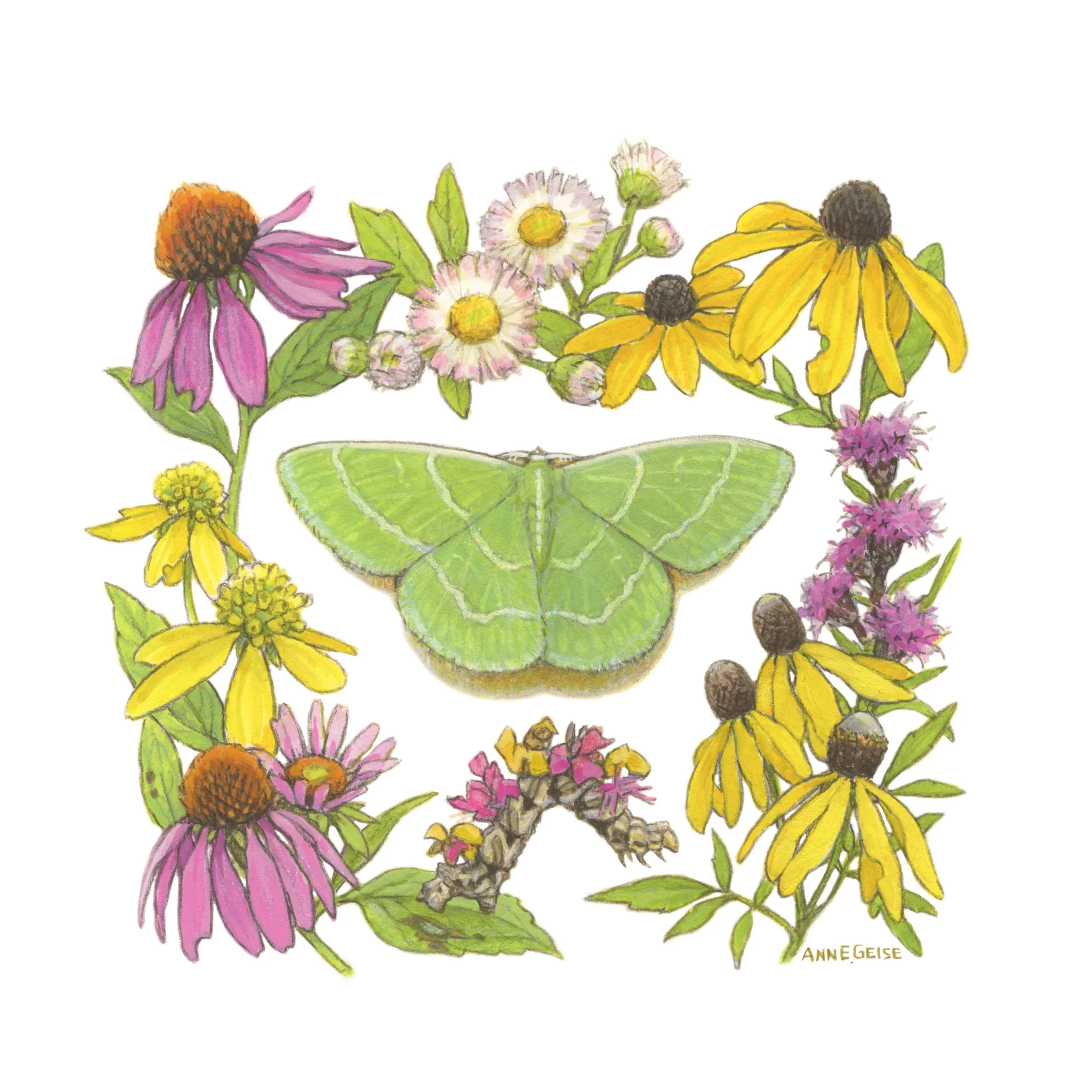
Our 2026 Moth of the year is the Wavy-Lined Emerald Moth. This beautiful artwork by Ann Geise depicts the Emerald Moth and Camouflaged Looper among Purple Coneflower, Fleabane, Liatris, Gray-headed Coneflower, and Wingstem.
Schedules, Presentations, Field Trips, Workshops, Speakers & Leaders will be added throughout the year as we plan our event in detail. Reserve your tickets now to ensure your spot for another great event!
The Event! Located in the Shawnee State Forest, we will have the opportunity to witness large numbers of moth species and other nocturnal insects that will be attracted to our specially-installed light stations, all while under the mentorship of expert naturalists. Evening presentations will be hosted at the Southern Ohio Museum and Cultural Center in Portsmouth, Ohio. Be prepared to stay up late into the night, so come well-rested!
Optional Friday and Saturday afternoon guided hikes will expose participants to the stunning beauty of the area, with additional sit-down classes. After you register, and once we get closer to the event, we will be emailing you details on these offerings, asking you for your preferences, and then confirming your assignments by email, along with all the driving directions you’ll need for the entire weekend.
Drawing us in like moths to flame. For those of us who think of moths as mostly errant, drab-colored creatures that accidentally stray into our homes through an open door, an intentional encounter with moths in their natural environment - with their exquisite wing patterns, often brightly furred bodies, and remarkable diversity - is a transformative experience. Once hooked on mothing, hot mid-summer nights will never be the same.
Ohio has over 3,000 species of moths - ranging from micro moths a few millimeters in size to giant silk moths larger than the palm of our hands. True, some look like "little brown moths," but others look like they are woven out of the finest tapestry or that they have borrowed the hues of fruit sherbets. Moths can look just like wasps, hummingbirds, bird droppings, owl eyes and even spiders! And, they bear marvelous names, like Blurry Chocolate Angle, Pistachio Emerald, Scribbler, Green Marvel, Betrothed, Penitent, German Cousin, and Blinded Sphinx, just to name a few!
Questions? If you have any questions, contact our Education Coordinator, Cassidy Drummond, at 937-794-3360.
Cancellation policy. In case of cancellation, refunds will be granted in full up until May 17, 2026. After that time, all payments are final and, if not used, will be recorded as a tax-deductible donation to the Arc of Appalachia. Registrations are transferable. If transferring your registration to another party, please be sure to give us your recipient’s name and email.
Lodging. Rooms have been set aside at the Shawnee Lodge & Conference Center. Please call the Shawnee Lodge to book your stay (740.858.6621). Please mention ‘Mothapalooza’ when calling to book your stay. Lodging reservations are made separately from our online event registration process. There are also several hotels and airbnb options in the Portsmouth area.
What if I am a beginner at mothing? BEGINNERS ARE WELCOME AND ENCOURAGED! Previous experience is not at all necessary, and we are eager to help beginners enjoy the event. Special training and orientation programs are available to beginners on Friday afternoon. Fortunately, unlike butterflies, once moths land on a lighting sheet, they usually relax and will linger quietly for minutes, sometimes hours, allowing you to closely approach, providing plenty of time to take photographs (even your cell phone will do) to facilitate identification, which, for the sake of convenience, often takes place the following day.
Bringing a field guide and loading on Phone Apps before you come is recommended. We highly recommend Peterson's Field Guide to Moths of Northeastern America, by David Beadle and Seabrooke Leckie. On your phone, we highly recommend LEPS by Fieldguide, iNaturalist, and iSeek by iNaturalist.
Pack along shoes for getting in the water. A few of our Saturday field trips will be in the water. For those outings, bring something equivalent to Tevas or Chacos, or old-fashioned tennis shoes - whatever shoes you don't mind getting wet.
What if it rains? Rain will definitely make mothing challenging if we have a long, steady downpour. Chances are, any summer rains we have will be brief, and we will be able to work around them. It would be unusual to get wiped out two nights in a row. That said, rain is a risk we just have to take.
What should I bring?
Cell phone for moth ID apps like LEPS and iNaturalist
a strong handheld flashlight separate from your phone
Raingear
Moth field guide of choice
Water bottle and a day pack to carry it in
Water-worthy sandals or shoes if you are going on an aquatic field trip
a notebook or clipboard, pen, pencils, and paper (for sketching and field notes)
Pocket money for snacks and small purchases
A light-weight, wide-brimmed hat for sun protection
Personal care items (soap, shampoo, etc.); Sunscreen if you use it (note there are also environmental reasons not to- check it out);
Sunglasses if you are sensitive to bright sunlight
First aid kit appropriate to your needs
Optional. Insect repellent for ticks & chiggers, see details below.
Cell phone coverage and internet are limited: Please note that cell phone coverage is spotty, and connectivity depends on your phone service company.
Comfort in the out-of-doors: We will be spending most of our time in the field, so please pack clothing that will allow you to be comfortable in a variety of weather conditions. In southern Ohio, the low to mid-nineties are common daytime highs in July. If you work daily in an air-conditioned environment, you might be wise to prepare for the course by taking mid-day walks so you can begin adjusting to midsummer outdoor temperatures. Nighttime lows are widely variable, anywhere from the high sixties to eighty degrees. Hot nights produce better mothing experiences.
Emergency Messages: Emergency messages for course participants can be left at the mainline of the Highlands Nature Sanctuary (937) 365-1935 during daytime hours.
Poison Ivy. You will have minimal but possible exposure to poison ivy. In any case, the leaders know the plant well and will help you avoid exposure. If you do touch the leaves, washing vigorously with soap within an hour avoids reactivity in most people.
Please click here to learn about the considerable hazards presented by ticks and chiggers, and prepare your own insect repellant that is safe to use, affordable to make, and will give you the confidence to enjoy the out-of-doors.